Application modernization
Reduce technical debt and evolve legacy systems while protecting business continuity.

Explore common challenges where connected application, platform, infrastructure and operations engineering can create practical business value.
Discuss your challenge →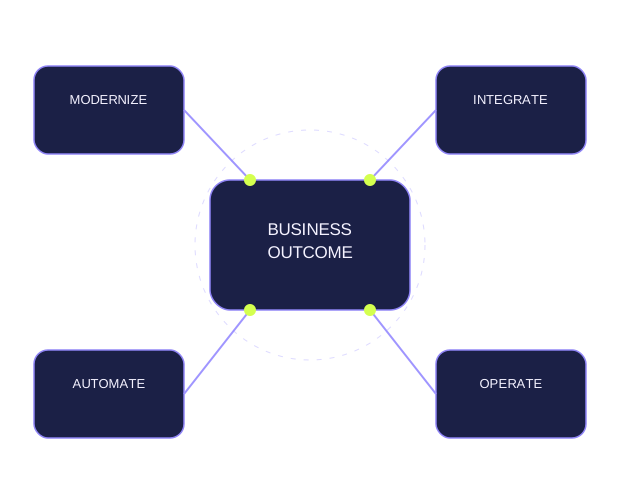 Enterprise Use Cases
Every environment is different, but many organizations face familiar constraints.
Reduce technical debt and evolve legacy systems while protecting business continuity.
Build controlled cloud environments with clear governance and operational ownership.
Connect applications and data flows through secure, maintainable integration patterns.
Improve service visibility, diagnosis and reliability across distributed environments.
Refresh aging infrastructure and establish repeatable automation.
Turn open technologies into supportable, governed enterprise capabilities.
We start with the outcome and select the engineering disciplines required to achieve it.
Map the business problem, systems, dependencies and constraints.
Identify the highest-value changes and the risks to manage.
Design the target state and a realistic sequence of delivery.
Implement, validate and transition capabilities in stages.
Review operational and business outcomes, then improve.
Many enterprise outcomes require more than one service line.
Application architecture + modernization + quality engineering.
OpenStack + infrastructure engineering + operations.
Observability + automation + service reliability.
Technology assessment + governance + lifecycle operations.
Share the challenge, the systems involved and what a better outcome would look like.
Start a conversation →Different challenges. A connected engineering response.
The scenarios below illustrate how CloudHarmonix capabilities can be combined. The exact architecture and delivery scope depend on the organization's environment and objectives.
Assess dependencies and technical risk, prioritize a modernization path, then refactor, re-platform or replace components in controlled stages.
Define workload and governance requirements, design the OpenStack architecture, automate deployment and establish day-two operations.
Map data ownership and integration boundaries, design secure APIs or messaging patterns, and introduce monitoring and failure handling.
Identify critical services and observability gaps, improve alert quality, define incident practices and automate repeatable response tasks.
Evaluate technology fit, component risk, governance obligations and lifecycle ownership before production rollout.
Start with the constraint that matters most.
A focused first phase can clarify the problem and help teams avoid committing to a solution before the technical and operational context is understood.
Understand the architecture, systems, stakeholders and known pain points.
Separate urgent risks from longer-term improvements and identify dependencies.
Compare feasible approaches, trade-offs, assumptions and operating implications.
Define work packages, decision gates, responsibilities and success measures.